Blind Spot Test
Close your left eye and look at the cross with your right. A red dot moves away to the right: at one point it vanishes, then it comes back. That gap is your blind spot, measured on your own screen.
Close or cover your left eye. Look only at the cross with your right eye, about an arm's length away. Press Space or tap when the dot vanishes, and again when it comes back.
Where the blind spot is
At the back of each eye, about 4 mm toward the nose from the centre of sight, a million nerve fibres gather into the optic nerve and leave the eye. That disc has no light cells.
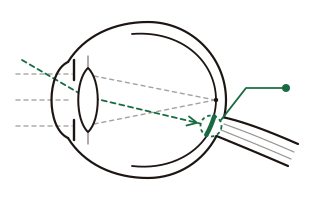
About 15° to the side of where you look, slightly below the horizon: out toward the ear in your field of view.
About 5–6° wide and 7–8° tall: at arm's length, a patch the size of a fist could vanish in it.
You never notice it because the other eye sees that spot, and the brain fills the gap with the surrounding pattern even with one eye.
Try it with paper
Draw a cross and a dot about 8 cm apart on a card. Close your left eye, look at the cross with your right, and bring the card slowly toward your face: at about 25–30 cm the dot disappears.
Your blind spot as a ruler
Because the blind spot sits at the same angle in everyone (about 15.5°), the point where the dot vanishes tells how far your eye is from the screen. Researchers use this to size web experiments without a chin rest (the 'virtual chinrest').
The sum: distance = dot offset ÷ tan 15.5°. A dot vanishing 14 cm from the cross means your eye was about 50 cm away.
When it is wider than usual, or there is a second gap elsewhere, a peripheral vision test maps the rest of the field.
Questions
Why don't we see our blind spot?
Each eye's blind spot falls on a part of the scene the other eye sees, and with one eye the brain fills it with the colour and pattern around it.
Can the blind spot get bigger?
Yes: a swollen optic disc (papilloedema), glaucoma and some optic nerve diseases enlarge it. A blind spot clearly larger than 7° or growing between tests is worth an eye exam.