Eye Dominance Test
Frame the red dot through a triangle made with your hands (or point at it), then close each eye in turn. The eye that keeps the dot in place is your dominant eye.
- Stretch both arms out and make a small triangle with your thumbs and forefingers.
- With both eyes open, frame the dot on the screen inside the triangle.
- Close your LEFT eye. Is the dot still inside the triangle?
Two methods, one answer
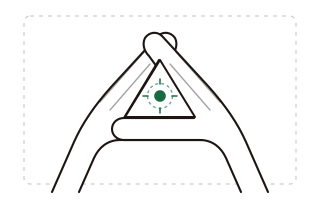
Miles test (hands triangle). Both hands, both eyes open: the brain picks one eye to aim through the gap. The most reliable home method.
Porta test (pointing). One finger lined up on the target. Quick, but the hand you point with can pull the result toward the same side.
Do both, at a target 3–6 m away (a light switch, a doorknob) as well as on the screen. Agreement means a clear dominant eye.
Cross-dominance: hand on one side, eye on the other
About a third of right-handed people are left-eye dominant. It matters when you aim along a line from one side of the body: shooting, archery, darts, golf putting, photography.
right-eye dominant
The usual pattern, most common with right-handedness.
left-eye dominant
Common among left-handers, and in a third of right-handers.
no clear dominance
Both eyes share the job; the result changes between tries.
Shooters who are cross-dominant either shoot from the dominant eye's side, or close or blur that eye with a patch on the glasses.
Questions
How to tell which eye is dominant?
Make a small triangle with your hands at arm's length around a distant object with both eyes open, then close one eye. If the object stays in the triangle, the open eye is dominant.
Does eye dominance matter for glasses?
For monovision contact lenses or laser surgery, the dominant eye usually keeps distance focus and the other eye takes near. For ordinary glasses it does not change the prescription.
Can eye dominance change?
It can shift with age, after cataract surgery or when one eye loses sharpness. It is usually stable in healthy adults.