Measure PD Online
Hold a bank card against your forehead, take a webcam photo, and the tool finds your pupils and uses the card's 85.6 mm width as the ruler. You get your distance PD and near PD in millimetres.
Hold a bank card flat against your forehead or under your nose, magnetic strip toward the camera, and look straight into the lens from about 40 cm.
Three ways to measure your PD
Card and camera
The card sits in the same plane as your eyes, so its known width turns pixels into millimetres. Look straight into the lens from about 40 cm; repeat twice.
PD ruler in a mirror
Print the ruler, stand 20 cm from a mirror, line 0 up under one pupil with that eye open, then read under the other pupil. Open the PD ruler
Someone else's eye
Look at the helper's nose 40 cm away while they hold a mm ruler at your brow and read the gap between your pupil centres: the most exact home method.
Average pupillary distance
Adult PD is 54–74 mm; 63 mm is the average across adults. A PD far outside the range for your group is worth measuring again.
Is a PD of 72 normal? Yes, at the wide end for men. Kids' PD grows until about age 15.
Distance PD, near PD and dual PD
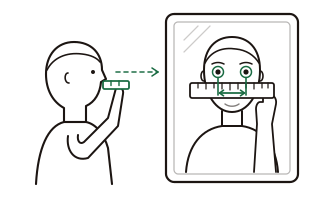
Distance PD: eyes looking far, the number for everyday and distance glasses.
Near PD: eyes turned in to read, about 3–4 mm less. For single-vision reading glasses. This tool works it out for 40 cm.
Dual (monocular) PD: each eye to the centre of the nose, written 31.5/32. Needed for varifocals and strong prescriptions, because faces are rarely symmetric.
On a prescription PD may be written "PD 63" or "63/60" (distance/near). Read your prescription
Questions
Why won't my optician give me my PD?
In the US, opticians must give you your prescription, but PD is often treated as part of fitting glasses, not the prescription. You can ask for it, or measure it here.
Is it okay if my PD is off by 1 mm?
Yes for most prescriptions: 1–2 mm makes no noticeable difference under about ±2.00. Strong lenses and varifocals are more sensitive.
Can you measure pupillary distance from a picture?
Yes, if something of known size is in the same plane as the eyes, like a bank card held to the forehead. Upload a photo taken straight on.
Do I need a PD measurement app?
No: this page runs in the browser and works with any webcam or phone camera. The photo stays on your device.