Deuteranopia
Deuteranopia is red-green colour blindness with no working green (M) cones. Reds, oranges, yellows and greens fall on one range of yellowish-brown, told apart by lightness.

Which cones deuteranopia affects
The green (M) cones are missing, so colours that differ only for them look the same.
Colours that run together: red and green, green and beige, purple and blue, pink and grey.
Family: red-green colour vision deficiency.
Everyday scenes with deuteranopia
How common it is and how it is inherited
men
women
women carry a red-green gene
Inheritance: X-linked recessive: passed from a carrier mother to half her sons.
The gene for the green cone pigment (OPN1MW) sits on the X chromosome next to the red one; in deuteranopia it is missing or replaced by a red-like copy.
A father with it passes the gene to every daughter (as carriers) and to none of his sons. A woman has it only when her father has it and her mother carries it.
Rates are highest in men of Northern European descent; in East Asian and African populations red-green deficiency of all types is about half as common.
How the test finds it
Misses the red-green plates at every level; on two-digit plates reads only the right digit.
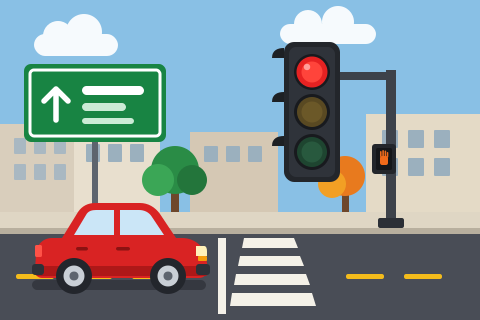
- Traffic lights are read by position (red top, green bottom).
- Ripeness of fruit and doneness of meat are judged by texture, not colour.
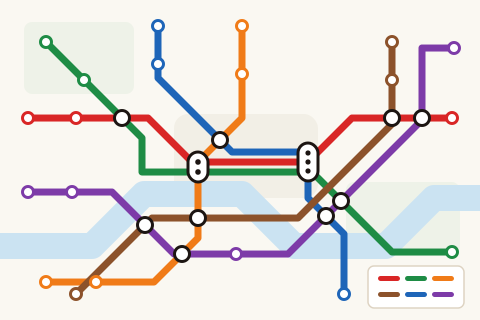
- Red-green charts and maps need labels or patterns.
Questions
Is deuteranopia a disability?
It is not counted as a disability for everyday life or an ordinary car licence. A deuteranope usually fails the colour standards for commercial pilots, train drivers, marine officers and many electrical trades, where alternative lantern or CAD tests rarely pass a full dichromat.
Can deuteranopia be corrected?
No. Glasses cannot add green cones, and notch-filter glasses mostly help people whose cones are only shifted. For a deuteranope a phone or screen filter that recolours reds and greens, plus labels on charts and wires, does more.